Gallop across the Inner Mongolia grasslands, and you’ll truly understand the meaning of the line—”The sky is vast, the wilderness boundless”; the wind carries nothing but the scent of freedom.
The wind here carries the breath of nomadic civilizations spanning millennia, sweeping across the grasslands that stretch endlessly to the horizon and caressing the undulating sand dunes.Among the lush green grass of the Huitengxile Grassland, white wind turbines spin with poetic grace, while the Ninety-Nine Springs mirror the blue sky, white clouds and flocks of white sheep grazing nearby.The dawn and dusk over the Xilamuren Grassland hold the fascinating wonder of “wearing a cotton-padded jacket in the morning and a thin gown at noon”, and the vastness of this semi-desert grassland remains utterly captivating.The dunes of the Kubuqi Desert roll like waves; the exuberant bustle of Xiangshawan (Singing Sand Bay) and the tranquil serenity of the Night-Singing Sand dunes together paint the dual charms of the desert landscape.
Hulunbuir Grassland
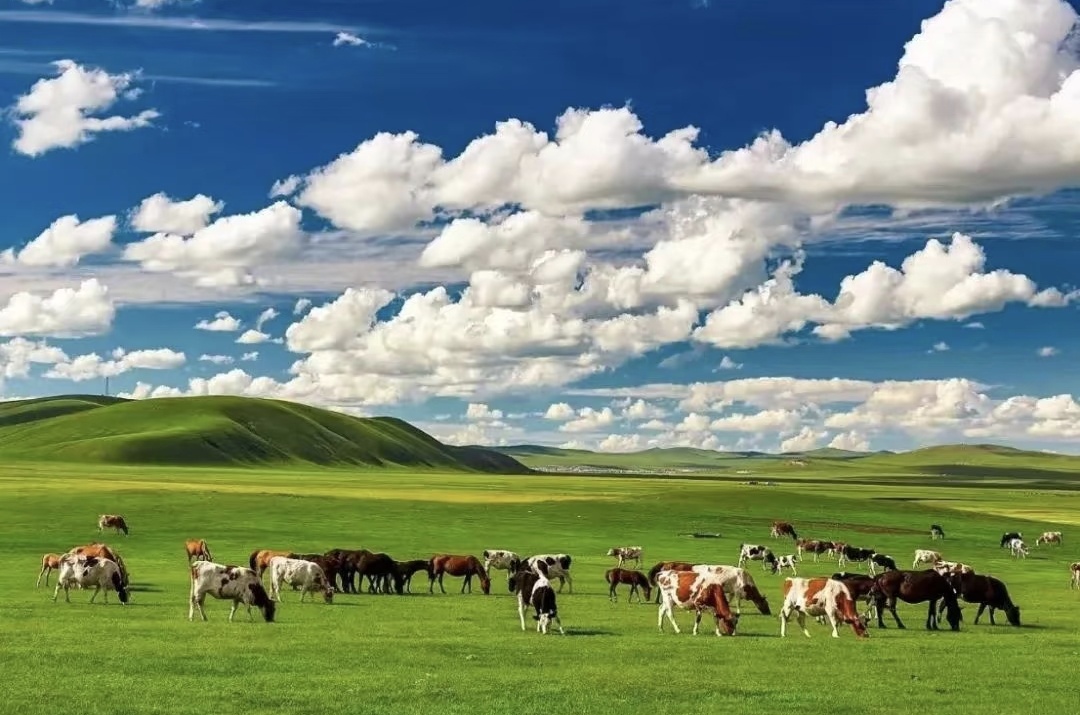
Hulunbuir Grassland, hailed as “the best grassland in the world”, unfolds like a emerald-green carpet stretching endlessly to the horizon. Gallop on horseback deep into the grasslands, where herds of cattle and sheep dot the landscape like scattered pearls. The Ergun River winds through the terrain like a silver ribbon, splitting the grassland into two distinct hues—one side lush green, the other golden yellow.
As dusk falls, gather around a yurt to watch the setting sun dye the grassland a warm tangerine red. Local herdsmen strum the horse-head fiddle, their melodious songs drifting far with the evening breeze. The mouth-watering aroma of roast whole lamb fills the air, and the night on the grassland brews romance into an eternal memory.
Xiangshawan (Singing Sand Bay)
Xiangshawan, known as “the Disneyland of the desert”, boasts golden sand dunes that glow dazzlingly under the sun. Hop on a desert buggy to race across the sea of sand, with the rustling sound of sand grains colliding in your ears. Hike to the top of a sand dune, spread your arms wide, and feel as if you can embrace the entire desert.
Stay overnight in a yurt hotel nestled in the desert. Look up to marvel at the glittering starry sky, where the Milky Way shimmers clearly above. At dawn, watch the sun rise slowly behind the sand dunes, painting the desert in a breathtaking shade of golden red—an experience that feels like stepping into a dreamy fairyland.
Ejina Populus Euphratica Forest
Ejina Populus Euphratica Forest, dubbed “the guardian of the desert”, transforms into a stunning spectacle every autumn. The leaves of the populus euphratica trees turn a brilliant golden yellow, and the vast forest blazes like a sea of fire.
Wander along the wooden plank paths that wind through the forest, where sunlight filters through the leaves, casting dappled shadows on the ground. In the Ghost Forest, the withered populus euphratica trees take on strange and varied shapes—some resemble camels raising their heads, others like eagles spreading their wings—exuding a desolate yet striking beauty. In the evening, visit the Black City Ruins, where the ancient city walls stand more majestic and vicissitudinous under the sunset, as if whispering tales of thousands of years of history.
Arxan National Forest Park
Arxan National Forest Park, a “natural oxygen bar”, is home to vast primeval forests and crystal-clear lakes. Towering mountains rise steeply on all sides, their slopes blanketed in dense forests. The Shitang Forest, formed by volcanic eruptions, is covered with rocks overgrown with moss and low-lying plants, exuding a primitive and untouched charm.
Take a deep breath here, and the fresh air—fragrant with the scent of trees and grass—will refresh your mind and body completely.
Xilingol Grassland
Xilingol Grassland, celebrated as “the cradle of nomadic culture”, features not only boundless pastures but also numerous historical and cultural relics. The Ruins of Xanadu, the former capital of the Yuan Dynasty, bear witness to the dynasty’s glorious past. Even in its current state of broken walls and dilapidated palaces, the ruins still evoke vivid images of its former prosperity.
Join the Nadam Fair held on the grassland to watch herdsmen compete in traditional events such as wrestling, horse racing, and archery, and immerse yourself in the rich nomadic cultural customs. As night falls, dance around a crackling bonfire with the herdsmen, and experience the boundless enthusiasm and unrestrained spirit of the grassland.
Best Time to Visit
Spring (April–May)
During this period, the grasslands in eastern Inner Mongolia start to turn green, and apricot and peach blossoms burst into bloom one after another. It is an ideal time to admire the grassland scenery and flowers in spring. However, temperatures are relatively low in spring and sandstorms are frequent, so it is necessary to bring sandproof supplies and warm clothing.
Summer (June–August)
This is the golden season for grassland tourism in Inner Mongolia. The grasslands stretch out in an endless expanse of lush green, dotted with herds of cattle and sheep. The temperature is pleasant, with an average range of 20–25℃, perfect for activities like horseback riding, camping, and attending the Nadam Fair. Note that the ultraviolet (UV) radiation on the grasslands is strong in summer, so sun protection products are a must.
Autumn (September–October)
This is the prime time to visit the Ejina Populus Euphratica Forest in western Inner Mongolia. The leaves of the populus euphratica trees turn a brilliant golden yellow, creating a magnificent landscape where the desert and the golden forest complement each other. Meanwhile, the grasslands in the east gradually turn yellow, presenting a unique scene of desolate beauty. Temperatures drop gradually in autumn, and the temperature difference between day and night is significant, so warm clothing is essential.
Winter (November–March of the following year)
Inner Mongolia is covered in a blanket of snow in winter, making it a great destination for ice and snow tourism. You can head to places like Hulunbuir and Xilingol to participate in the Ice-Snow Nadam Fair, go skiing, or enjoy hot spring baths. However, winter temperatures are extremely low—dropping below -30℃ in some areas—so strict warm-keeping measures are required. Additionally, some scenic spots may be closed, so it is advisable to check the opening status of the attractions in advance before your trip.
Inner Mongolia Cuisine Recommendations
Hand-Grasped Lamb:Using fresh lamb as the main ingredient, the meat (with bones attached) is cut into large chunks and boiled in water with minimal seasonings. This cooking method preserves the original flavor and tenderness of the lamb to the fullest.The finished lamb is juicy and tender with no gamey taste. Eaten directly with hands, it’s a hearty and satisfying treat. As one of the most iconic delicacies on the Inner Mongolia grasslands, it pairs perfectly with Mongolian milk tea for an even more delightful flavor.
Roast Whole Lamb:Selecting free-range lambs raised on the grasslands, the whole lamb is marinated with special seasonings and then slowly roasted over charcoal fire. When fully cooked, the lamb boasts a golden, crispy outer skin and tender, succulent meat inside, releasing an irresistible aroma.Enjoying roast whole lamb follows a unique ritual: the host usually carves off the first slice of meat before it is shared among all guests. It is a signature dish that Inner Mongolia people serve to honor distinguished visitors.
Mongolian Milk Tea:Made from brick tea, milk, butter, salt and other ingredients, the tea is prepared by first boiling the brick tea, then adding milk, butter and salt, stirring thoroughly and boiling again.Rich and smooth with a well-balanced salty flavor, Mongolian milk tea not only quenches thirst but also replenishes energy. It is an indispensable daily drink for Inner Mongolia herdsmen, often enjoyed with milk curd and roasted millet.
Milk Curd:A traditional dairy product of Inner Mongolia, milk curd is made by fermenting cow’s milk or goat’s milk. It comes in various shapes, including blocks and slices, with a firm texture and a rich, creamy taste that is slightly sour.Nutritious and versatile, it can be eaten as is, pan-fried, roasted, or soaked in milk tea.
Sand Leek Dumplings:These dumplings are filled with a savory mixture of sand leeks and lamb. Sand leeks are a type of wild vegetable growing on the edge of deserts, boasting a delicious, unique fresh fragrance that complements the lamb perfectly.